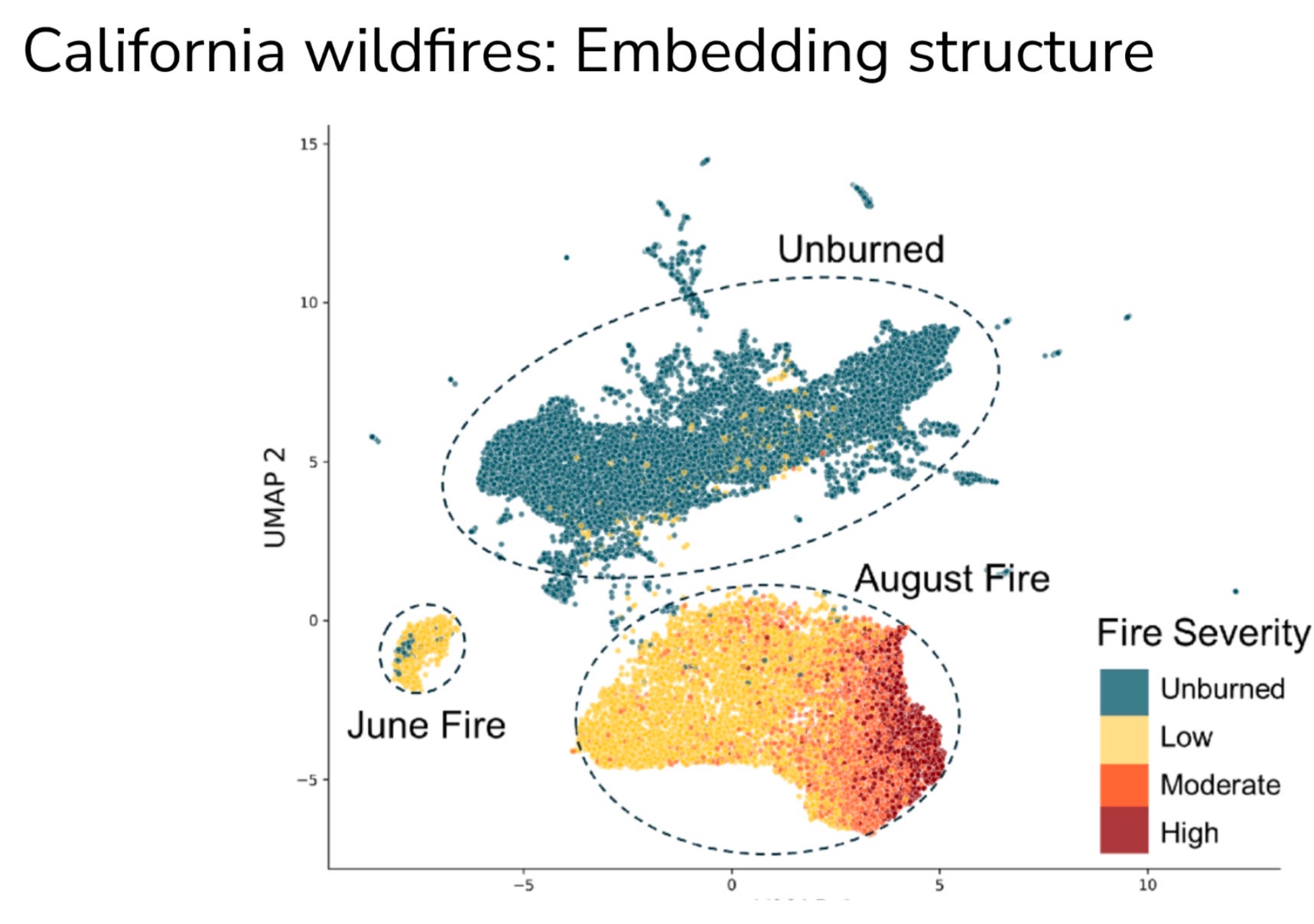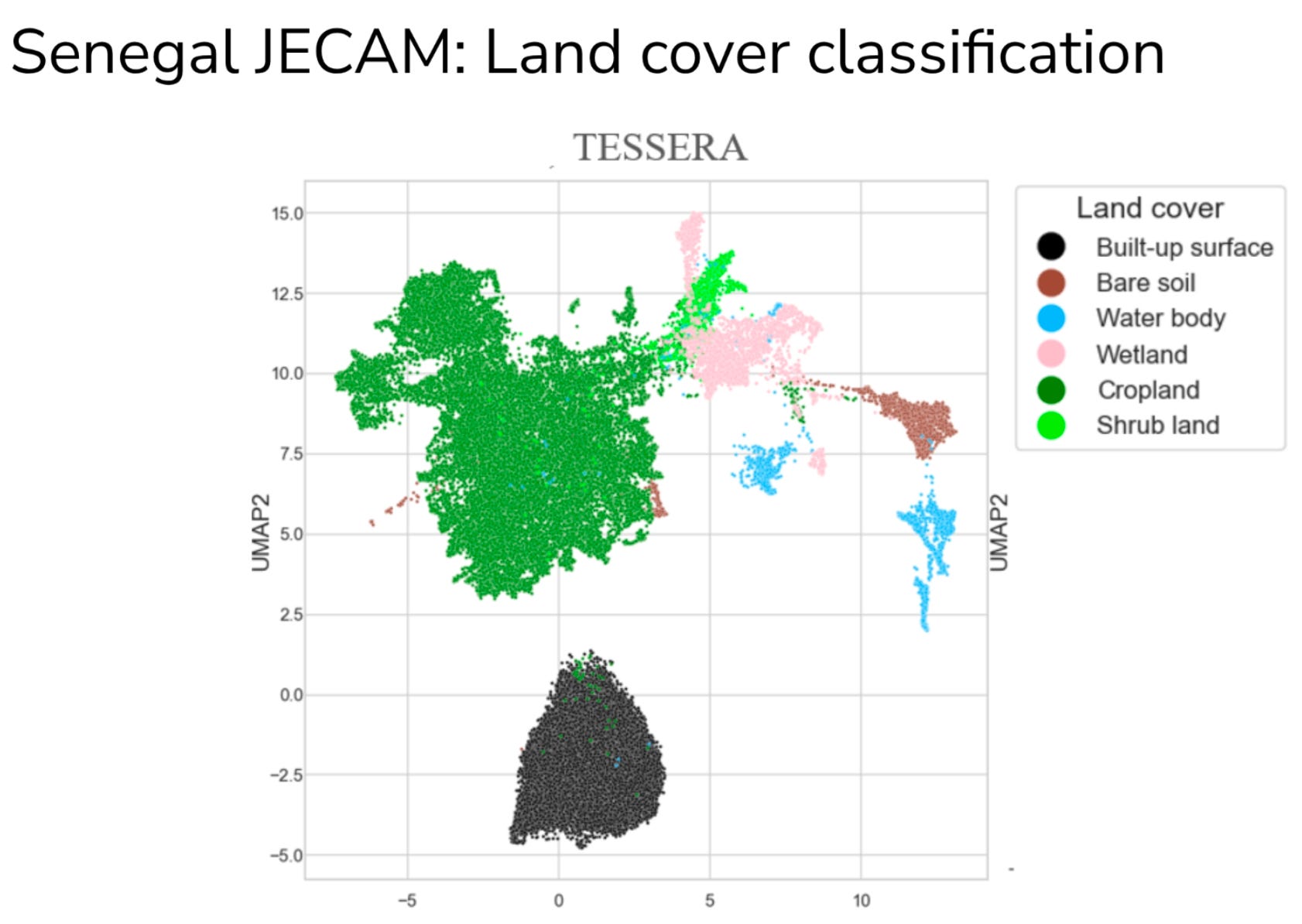

In this episode I caught up with Sadiq Jaffer and Frank Feng to discuss Tessera, a large-scale foundation model for Earth observation that produces annual, pixel-level temporal embeddings from multi-sensor satellite data. They explain why moving beyond single-date imagery is essential for understanding phenology, land cover, and environmental change, and how aggregating a full year of Sentinel-1 and Sentinel-2 observations enables far richer representations of the Earth’s surface. We dive into the unique engineering challenges behind Tessera, including its unusual cost profile where inference is more expensive than training, the need to ingest petabyte-scale archives, and the design choices required to scale a pixel-based model without representation collapse. Frank walks through their self-supervised training strategy based on redundancy reduction (Barlow Twins), while Sadiq highlights how downstream evaluations—from wildfire analysis to land-cover mapping—demonstrate that the embeddings already encode meaningful temporal and semantic structure. We also discuss the practical impact for ecology and conservation, where Tessera dramatically accelerates research workflows and reduces label requirements, and look ahead to Tessera v2, which will incorporate Landsat data to extend embeddings back to the 1970s and unlock new capabilities in change detection and forecasting.
Slides discussed in the episode