

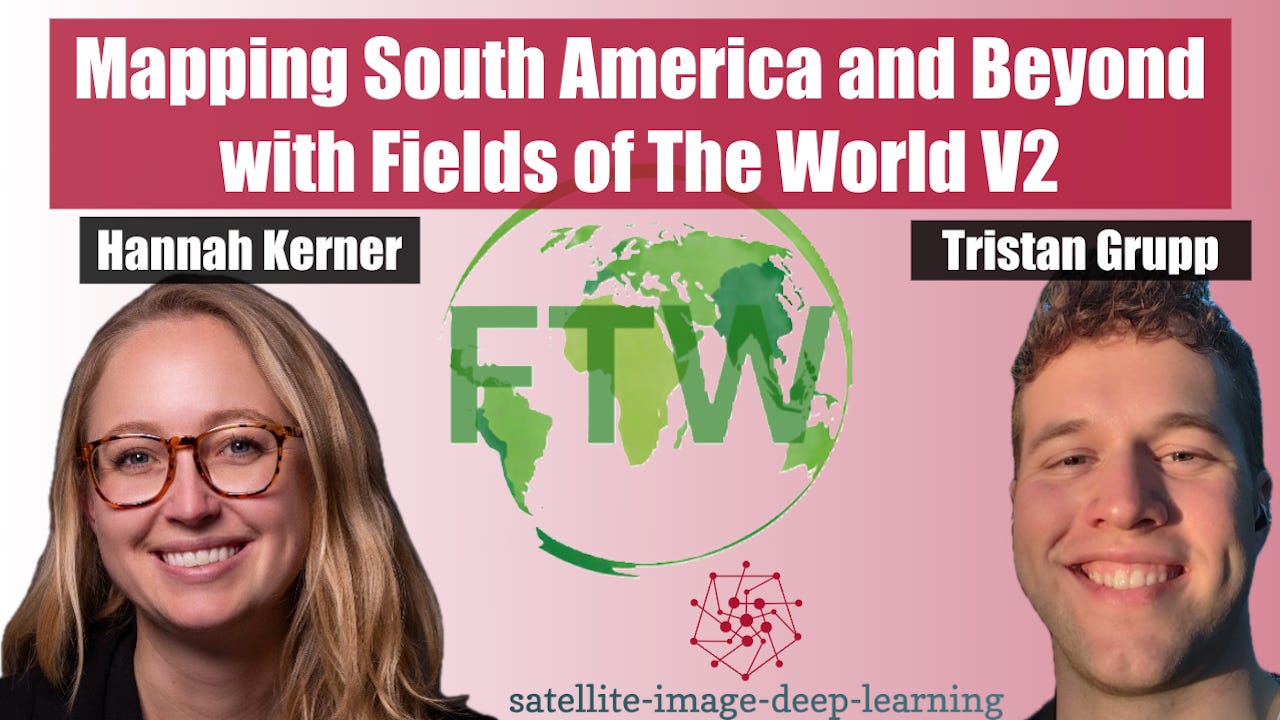
In this episode I sat down with Hannah Kerner and Tristan Grupp to discuss Fields of The World (FTW), an open-source benchmark and ecosystem for global field boundary segmentation from satellite imagery. We explore the core challenge of building models that generalise across vastly different agricultural systems, and why data diversity, rather than model architecture, is often the limiting factor. Hannah and Tristan explain how targeted annotation in underperforming regions can dramatically improve results, how combining global and local training data avoids catastrophic forgetting, and what they learned from large-scale model experimentation. We also dig into practical evaluation beyond standard IOU metrics, including consistency and throughput, and how small modelling choices like boundary loss weighting can have outsized impact on usability. Finally, we cover the growing tooling ecosystem, real-world user feedback, and what’s coming next, including improved models and a global map of predicted field boundaries.
Bio Hannah: Hannah Kerner is an Assistant Professor in the School of Computing and Augmented Intelligence at Arizona State University. Her research focuses on advancing the foundations and applications of machine learning to foster a more sustainable, responsible, and fair future for all. Her lab’s research topics include machine learning for remote sensing, algorithmic bias, and machine learning theory. She translates research advances to real-world impact through her roles as the AI/Machine Learning Lead for NASA Harvest and NASA Acres, Center Faculty for the ASU Center for Global Discovery and Conservation Science (GDCS), and Research Director for Taylor Geospatial. She has been recognised by multiple research awards including NSF CAREER (2025), Schmidt Sciences AI2050 Early Career Fellowship (2025), and Forbes 30 Under 30 in Science (2021).
Bio Tristan: Tristan Grupp is an Agricultural Data Scientist in the Food, Land, and Water Program and Data Lab at the World Resources Institute. He collaborates closely with Land and Carbon Lab. His current research focuses on applying remote sensing and machine learning to monitor deforestation and natural land conversion driven by agricultural supply chains, supporting commodity traceability and corporate sustainability compliance, including under the EU Deforestation Regulation (EUDR). His work spans forest change monitoring, climate adaptation, and the intersections of food systems and natural landscapes. Beyond WRI, Grupp has contributed to research on climate change adaptation tracking in support of national adaptation planning under the UNFCCC, protected area policy evaluation in the EU, and tropical forest dynamics in the Peruvian Amazon. He has presented his work at international venues including AGU, COP, and the UN National Adaptation Planning Conference.


